

The Real Cost of Getting “How to Sell My Company” Wrong
If you’re wondering how to sell my company, here’s the short answer:
- Prepare 12-18 months early — clean financials, reduce owner dependency, document processes
- Get a professional valuation — based on real comps, not guesswork
- Hire an M&A advisor — they run a competitive process that generates 15-30% more proceeds
- Market to the right buyers — strategic buyers, PE firms, family offices, and search funds
- Survive due diligence — organized financials and a sell-side Quality of Earnings prevent re-trades
- Close and transition — negotiate your post-close role and protect your after-tax proceeds
Most owners spend decades building their business. Then they spend six to twelve months trying to sell it — and leave hundreds of thousands of dollars on the table because they started too late or skipped the wrong steps.
The stakes are real. For most business owners, the company represents 70-90% of their total net worth. A well-run sale process can generate 15-30% more proceeds than a poorly run one. On a $10M deal, that gap is $1.5M to $3M — the difference between a comfortable retirement and a stressful one.
The businesses that sell for the highest prices — and actually close — don’t happen by accident. They are the result of a structured process that starts long before a buyer ever sees a teaser document.
This guide walks you through every phase of that process, from the decision to sell through the wire hitting your account.
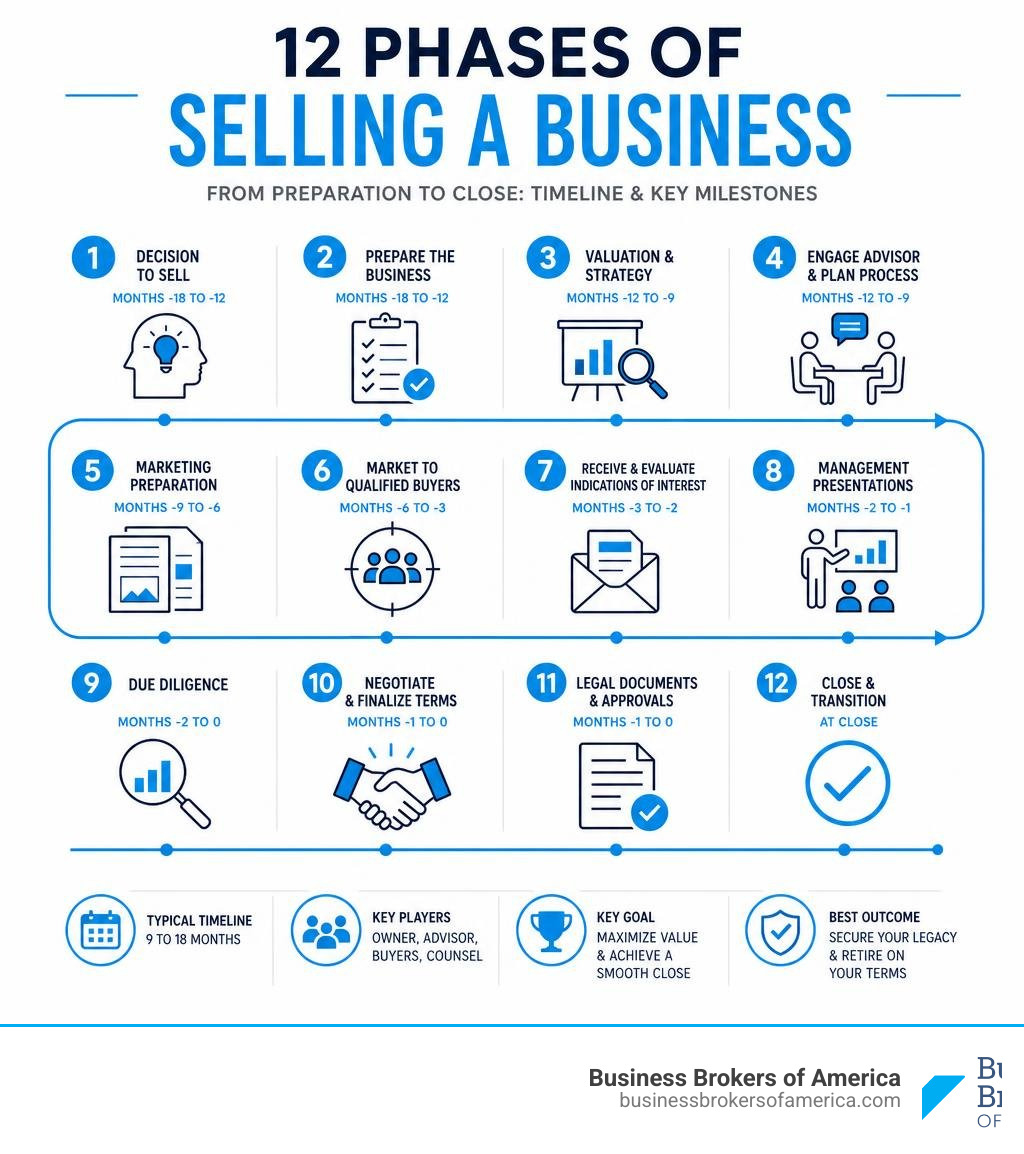
The 12-Phase Roadmap: How to Sell My Company Successfully
Selling a business is not a single event; it is a highly coordinated, multi-stage project. In the Arizona market—from the thriving tech and logistics corridors of the Phoenix metro area to the established service and contracting businesses in Tucson—executing these phases with precision determines your ultimate success.
While the actual go-to-market transaction typically takes 6 to 9 months after engaging an advisor, the most successful exits require a substantial runway of preparation. To understand the complete picture of this journey, it helps to review our guide on How Long Will It Take to Sell My Business.
When navigating the local landscape, incorporating Arizona-specific insights from resources like Selling a Business in Arizona: Tips, Tricks, and Financial Insights can save you from regional regulatory and tax pitfalls.
Below, we break down the 12 distinct phases of a professional M&A process into four logical groups.
Mental and Financial Readiness: How to Sell My Company vs. Testing the Market
The very first step of exit planning is evaluating whether you are truly ready to sell or if you are simply testing the market.
Many founders approach the process with a casual “let’s see what someone will offer” attitude. Buyers, particularly sophisticated private equity groups and corporate development teams, can spot an unmotivated seller instantly. If they sense you are just testing the waters, they will walk away to avoid wasting time and transaction costs.
To determine your readiness, you must answer two fundamental questions:
- Can the business run without you for 30 days? If your daily involvement is required to keep operations moving, you do not have a sellable company yet—you have a high-paying job.
- Do you have a clear post-sale plan? Owners who do not know what they will do on “Day 365” after closing often experience seller’s remorse, which is one of the leading causes of self-sabotaged deals mid-process.
Before moving forward, we highly recommend utilizing our Preparing to Sell Your Business Checklist to systematically grade your operational and financial readiness.
Phase 1 to 3: Pre-Sale Preparation and the Sell-Side Quality of Earnings (QoE)
The work you do 12 to 18 months before launching your business to the market is where the actual value of your company is unlocked. Rushing this window can cost you millions.
- Phase 1: Financial Cleanup (Months -18 to -12): Buyers demand three years of clean, tax-verified financial statements. We work with you to transition your books from cash-basis to accrual-basis accounting, establish a rigorous monthly close process, and separate personal expenses from business operations.
- Phase 2: Operational De-risking (Months -12 to -6): This involves documenting standard operating procedures (SOPs), securing long-term contracts with key customers, and building a strong middle-management team to reduce owner dependency.
- Phase 3: The Sell-Side Quality of Earnings (QoE) (Months -6 to -3): A sell-side QoE is an independent financial audit performed by a specialized CPA firm before you go to market.
A sell-side QoE typically costs between $35,000 and $150,000 depending on the size and complexity of your business. While this may seem like a steep upfront cost, its ROI is immense.
During due diligence, buyers will aggressively attempt to discredit your “add-backs” (owner’s salary, personal travel, one-time legal fees, etc.) to lower the purchase price. A sell-side QoE validates your adjusted EBITDA ahead of time, successfully protecting 50% to 80% of your claimed add-backs and preventing 60% to 70% of common buyer “re-trades” (price reductions mid-diligence).
Phase 4 to 6: Choosing an Advisor and Launching Buyer Outreach
Once your business is prepared, you must build your deal team and plan your market debut.
- Phase 4: Choosing Your M&A Advisor (Month 1): You need an experienced partner who understands your industry and deal size. For businesses valued between $1M and $30M, a specialized lower-middle-market M&A advisor is critical. Avoid generalist Main Street brokers who do not understand complex deal structures, as well as institutional investment banks that prioritize $100M+ transactions.
- Phase 5: Building the Marketing Suite (Months 2-3): Together with your advisor, you will draft three standard marketing documents:
- The Teaser: A 1-2 page highly confidential, “blind” document that outlines the investment opportunity without revealing your company’s name or exact location.
- The Non-Disclosure Agreement (NDA): A legally binding contract that every buyer must sign before receiving any identifying information.
- The Confidential Information Memorandum (CIM): A comprehensive 30-to-50-page document detailing your company’s operations, products, financial history, and growth opportunities. Crucial tip: Your CIM should highlight growth avenues (like an expansion plan into the Phoenix metro area) but must never include trade secrets, proprietary source code, or specific customer names. Save those for the highly secured virtual data room during late-stage diligence.
- Phase 6: Launching Buyer Outreach (Months 4-5): Your advisor will compile a highly targeted list of 75 to 150 qualified buyers. This list should be segmented into strategic buyers, private equity firms, family offices, and search funds. To learn more about how we curate these lists to protect your confidentiality, see our guide on How to Find a Buyer for Your Business.
Phase 7 to 12: From IOI and LOI to Due Diligence and Closing
The final stretch of the transaction is a , highly legal process where deal discipline is paramount.
- Phase 7: Indications of Interest (IOI) (Month 6): An IOI is a non-binding written offer that outlines a buyer’s preliminary valuation range and basic transaction structure. A competitive process should ideally generate 8 to 15 IOIs.
- Phase 8: Management Presentations (Month 7): We select the top 3 to 5 bidders to meet with you. This is your opportunity to evaluate their cultural fit and clarify their plans for your staff.
- Phase 9: Letter of Intent (LOI) (Month 8): The LOI is a formal, detailed offer. It is non-binding regarding the purchase price but is highly binding regarding confidentiality and exclusivity. You should aim to generate 3 to 5 competitive LOIs, allowing us to leverage bids against each other. Negotiation Tip: Keep the exclusivity period as short as possible—60 days is ideal, and you should never agree to more than 90 days.
- Phase 10: The Due Diligence Gauntlet (Months 9-10): Once the LOI is signed, you enter a 60-to-90-day exclusivity period. The buyer’s team of accountants, lawyers, and consultants will dissect every aspect of your business across financial, legal, commercial, IT/cyber, and environmental workstreams.
- Phase 11: The Definitive Purchase Agreement (Month 11): Attorneys draft the final legal contract (Asset Purchase Agreement or Stock Purchase Agreement). This phase also establishes the “working capital peg”—the amount of inventory and accounts receivable you must leave in the business at closing to ensure seamless operations.
- Phase 12: Closing and Transition (Month 12): The deal is signed, funds are wired, and you transition into your post-close role, typically governed by a Transition Services Agreement (TSA) lasting 3 to 12 months.
Maximizing Enterprise Value and Avoiding Deal-Killing Mistakes

Many owners believe that the value of their business is a fixed number. In reality, value is highly elastic.
A business with $2M in EBITDA can be worth $8M to a financial buyer, but worth $12M to a strategic buyer who can leverage immediate synergies. To secure the absolute top dollar for your hard work, you must understand how to position your company to the right audience.
To explore these valuation mechanics in depth, read our analysis on How to Maximize Business Sale Price. Additionally, to ensure you do not make critical errors along the way, review our breakdown on how to Avoid Mistakes Selling Business.
If you are operating in the local market, working with an experienced transactions attorney who understands How to Buy and Sell a Business in Phoenix Arizona is a critical step to keeping your deal on track.
The Buyer Landscape: Who Pays the Highest Multiples?
To maximize your proceeds, you must understand the different buyer archetypes active in the market today. Each category has distinct motivations, capital structures, and valuation parameters.
| Buyer Category | Typical EBITDA Multiples | Key Motivations | Transaction Dynamics |
|---|---|---|---|
| Strategic Buyers (Competitors, Suppliers) | 3.0x – 5.0x+ | Market share, geographic expansion, technology acquisition, cost synergies | Pay the highest multiples because they can immediately cut overlapping overhead. |
| Private Equity Platforms | 3.0x – 5.5x | Cash-flow generation, industry roll-ups, operational scaling | Highly professional, fast-moving, but strict on financial metrics and due diligence. |
| PE Add-Ons / Portfolio Cos | 3.0x – 6.5x | Synergistic expansion for an existing platform company | Fast integration, often backed by deep institutional private equity capital. |
| Family Offices | 2.0x – 3.0x | Long-term wealth preservation, steady yield, generational holds | More flexible terms, longer investment horizons, and highly supportive of existing management. |
| Search Funds / Individual Operators | 3.0x – 4.5x | Direct operational control, entrepreneurial career path | Often rely heavily on SBA 7(a) financing; highly dependent on clean seller transitions. |
Avoiding the Diligence Gauntlet: Why Deals Die Post-LOI
Roughly 25% to 30% of signed LOIs never make it to the closing table. When deals collapse in due diligence, it is rarely because of a sudden market crash; it is almost always due to self-inflicted wounds that could have been resolved during pre-sale preparation.
- Re-Trades: A re-trade occurs when a buyer lowers their offer price mid-process. This is usually triggered when their due diligence team uncovers financial discrepancies, unrecorded liabilities, or unvalidated add-backs. Running a sell-side QoE is your best insurance policy against re-trades.
- Customer Concentration: If a single customer accounts for more than 15% to 20% of your total revenue, buyers view your company as highly risky. If that customer leaves post-close, the buyer’s investment is ruined. You must diversify your revenue stream or secure long-term, transferable contracts with your top clients before going to market.
- Owner Dependency: If your customers buy from you because of your personal relationship, or if key operational decisions cannot be made without your direct approval, a buyer will discount your valuation heavily—or walk away entirely. You must systematically delegate your responsibilities to a capable second-in-command at least 12 months before listing.
- Messy Financials: Disorganized bookkeeping, mixing personal and business expenses, or failing to close books monthly destroys buyer trust. When trust is lost in due diligence, the deal dies.
Tax, Domicile, and Estate Planning for Arizona Business Owners
It is a common mistake to focus entirely on the “headline” purchase price of an offer. What truly matters is your net after-tax proceeds—the actual amount of cash that clears into your bank account after Uncle Sam and the state take their share.
To maximize this figure, you must coordinate with transaction tax counsel and wealth advisors at the very beginning of the process. For local owners, aligning your strategy with resources like Sell Your Arizona Business – AZBBA ensures you are taking full advantage of state-specific guidelines.
To discover how these tax structures fit into your broader exit goals, explore our comprehensive guide on Understanding Business Exit Strategies.
Structuring the Deal: Asset vs. Stock Sales
The legal structure of your transaction has massive tax and liability implications for both you and the buyer.
- Asset Sale: In an asset sale, the buyer purchases specific assets of the company (equipment, customer lists, IP, goodwill) rather than the corporate entity itself. Buyers strongly prefer asset sales because they can “step up” the tax basis of the acquired assets and depreciate them over time, saving them millions in future taxes. However, for you as the seller, an asset sale can trigger significant tax liabilities, particularly through depreciation recapture (where previously depreciated equipment is taxed at ordinary income rates rather than lower capital gains rates).
- Stock Sale: In a stock sale, the buyer purchases your actual corporate shares, taking over the entire legal entity including all historical liabilities. Sellers heavily prefer stock sales because all proceeds are taxed at favorable federal capital gains rates, and there is a clean transfer of legal liability.
M&A advisors play a critical role here by negotiating a compromise—such as adjusting the purchase price upward in an asset sale to offset the seller’s increased tax burden.
Arizona-Specific Tax Strategies and Domicile Changes
For business owners in the Phoenix metro area and statewide, local tax planning is incredibly favorable but requires careful execution.
- Arizona State Income Tax: Arizona features a highly competitive flat individual income tax rate of 2.5%. This makes exiting a business in Arizona significantly more tax-efficient than in neighboring states like California, which features top marginal rates of up to 13.3%.
- Domicile and Trusts: If you are planning a move or hold assets across state lines, establishing your primary tax domicile in Arizona well before the sale is critical. Utilizing trust structures such as Charitable Remainder Trusts (CRTs) or Grantor Retained Annuity Trusts (GRATs) can defer or eliminate substantial capital gains liabilities when structured correctly by an experienced wealth management team.
Frequently Asked Questions About Business Sales
What is the typical timeline when I decide how to sell my company in Arizona?
From the moment you engage an M&A advisor to the day the deal closes, the process typically takes 9 to 12 months. However, to achieve a premium valuation (15% to 30% higher proceeds), you should begin pre-sale preparation 12 to 18 months before engaging an advisor.
In the fast-moving Arizona market, well-prepared companies in the Phoenix metro area can sometimes close faster due to high demand from regional and national buyers, while complex or overpriced businesses can take over a year to find the right match.
What is a sell-side Quality of Earnings (QoE) and do I really need one?
A sell-side QoE is an independent financial analysis conducted by a third-party accounting firm prior to launching your business to the market. It goes beyond a standard tax return to validate your historical revenues, normalize your adjusted EBITDA, and verify your add-backs.
Yes, if your business has over $1M in EBITDA, you absolutely need one. It acts as “deal insurance,” protecting your valuation from aggressive buyer re-trades and ensuring a smoother, faster due diligence process.
How do M&A advisor fees work and what is the Lehman scale?
Most professional M&A advisors operate on a retainer plus success fee model. The retainer (typically paid monthly or upfront) covers the significant costs of business valuation, CIM preparation, and marketing launch. The success fee is a percentage of the final transaction value paid only when the deal successfully closes.
The success fee is often structured using the Lehman Scale or the Double Lehman Scale, which incentivizes advisors to secure the highest possible purchase price:
- 10% of the first $1,000,000 of transaction value
- 8% of the second $1,000,000
- 6% of the third $1,000,000
- 4% of the fourth $1,000,000
- 2% of everything thereafter
For larger lower-middle-market transactions, modern advisors often use a flat success fee (typically 4% to 8% for deals under $25M) or a scaled incentive structure that increases the commission percentage once a target valuation benchmark is exceeded.
Conclusion
When you decide it is time to ask, “how to sell my company,” you are preparing for the most significant financial event of your life. Navigating this complex process alone is a recipe for leaving millions on the table or watching a deal collapse in the final hours of due diligence.
At Business Brokers of America, we specialize in helping business owners nationwide—with deep local expertise throughout Arizona, including the Phoenix and Tucson metros—successfully navigate transitions for companies valued between $1M and $30M.
Our unique differentiator is our exit team of former business sellers. We don’t just understand the theory of M&A we have sat in your chair, faced the same anxieties, and successfully crossed the finish line ourselves. We combine this real-world experience with data-driven valuations and a vast, nationwide buyer network to generate an average of eight competitive offers per deal.
If you are ready to explore your options, protect your legacy, and maximize the value of your life’s work, we invite you to take the first step. Contact us today for a confidential, no-obligation conversation and a complimentary business valuation.
Let us help you transition your hard work into the retirement you deserve. Visit our primary resource on Selling a Business to get started today.