



Managing the sale of a business means running one coordinated project: preparing the company, reaching qualified buyers in confidence, turning interest into competing offers, getting through due diligence, and closing. Owners who treat it as a single event, rather than a sequence of stages with its own owner, usually lose value in the gaps between stages. We run that project for sellers, and this guide shows how it works, what each stage asks of you, and where deals tend to slip.
Key Takeaways
- A sale has five working stages: preparation, confidential marketing, offers and negotiation, due diligence, and closing. Each one depends on the quality of the one before it.
- Preparation starts well before listing. SCORE describes an exit timeline of one to five years, with the final 12 to 18 months spent on price expectations, a data room, and engaging an advisor.
- Price is shaped most by competition. Our approach is built around managing buyer follow-up so that offers compete, and our deals typically average eight bids.
- Due diligence is where buyers verify what you told them. Organized records and a pre-decided list of included assets keep it from turning into a renegotiation.
- Someone has to own the process day to day. Owners who try to do it alongside running the company often find that both suffer.
The phrase gets used for a lot of things online, and most of the pages you will find under it are about sales pipelines and CRM tools for selling products. This article is about something different: managing the sale of the company itself.
Wondering what your business is worth?
Get a personalized valuation backed by real market data.
Start your free valuationA business sale has a few features that make it unlike any other project you have run:
- It happens once, so you have no routine to fall back on.
- It is confidential. Employees, customers, suppliers and competitors usually should not learn about it before a deal is signed.
- It involves many parties at once: buyers, their lenders, attorneys, accountants, and sometimes a landlord or franchisor.
- Your leverage changes as the process moves. It is highest before a buyer has exclusivity and lowest after.
Process management is the discipline of controlling that last point. You decide who sees what, in what order, and when each buyer has to respond. If you do it well, you keep more than one serious buyer at the table until the contract is signed.
Stage 1: Preparation and goals
Preparation is the longest stage and the one owners most often compress. SCORE, the nonprofit mentoring organization partnered with the U.S. Small Business Administration, lays out a realistic exit timeline of one to five years. Three to five years out, the work is personal and strategic: set goals, work out how much you need from the sale to fund your next chapter, get a baseline valuation, and begin reducing the company’s dependence on you. From 18 months to three years out, the focus moves to cleaning up and standardizing financials, strengthening the management layer, and resolving contract, lease and legal loose ends. The final 12 to 18 months are for settling price expectations, organizing a data room, engaging an advisor, and moving from letter of intent to closing.
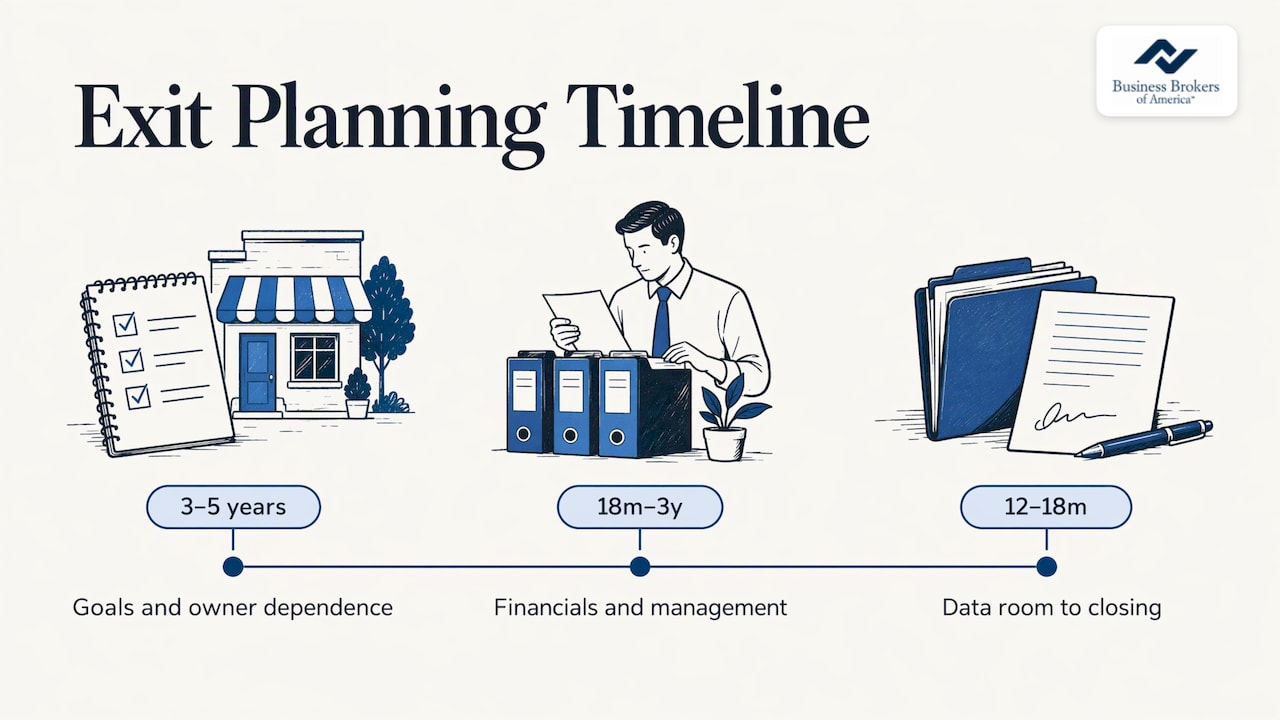
A data room is simply a secure, organized folder of the documents a buyer will ask for. Building it before you need it is one of the cheapest ways to speed up everything that follows.
Decide what you want before buyers ask
Before any marketing begins, write down four things:
- Your target closing window.
- The lowest price and structure you would accept.
- Your post-sale role, if any: a clean exit, a transition period of a few months, or a longer stay.
- Your non-negotiables, such as how employees are treated.
A CPA at K&M, an accounting and advisory firm, notes that preparing a company for sale can take 12 to 24 months or more, and that deciding between a full exit and partial liquidity early shapes the deal structure and the type of buyer you attract. Those answers also keep you steady when the first offer arrives and the temptation is to say yes out of relief.
Reduce your own role in the business
Buyers pay more for a company that runs without its owner. That means documenting how work gets done, developing a second layer of management, and spreading revenue across more customers with contracts in place. The same K&M guidance puts key-person dependency and customer concentration at the center of what buyers examine. If you want a fuller list of value drivers, our guide on how to increase business sale value walks through them.
Get a valuation you can defend
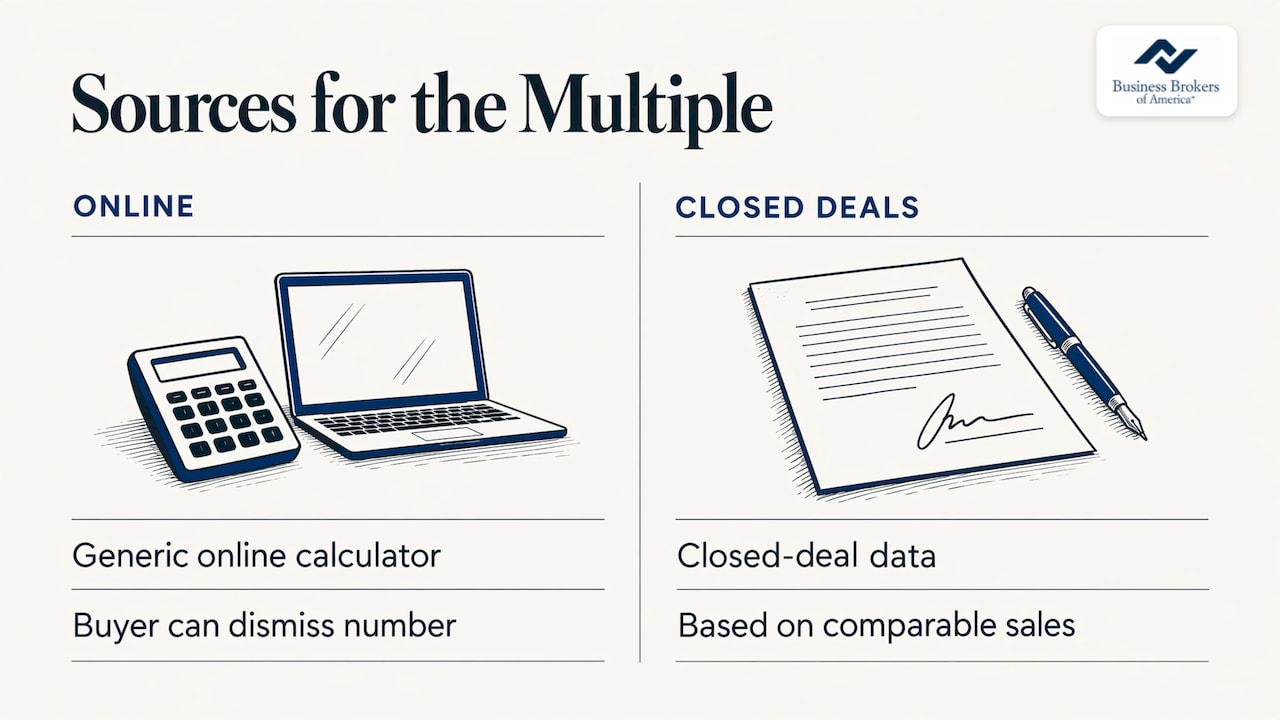
Small businesses are usually priced on seller’s discretionary earnings (SDE) rather than EBITDA. NerdWallet explains that SDE starts from pretax, pre-interest earnings, adds back the owner’s salary and benefits along with non-essential expenses, and then applies a multiple to arrive at a value. The multiple is where the judgment lives. It depends on industry, size, growth, customer concentration and how transferable the business is.
This is why the source of the multiple matters. A number pulled from a generic online calculator is easy for a buyer to dismiss. Our valuations use closed-deal data, so the asking price rests on what comparable businesses actually sold for. For the mechanics, see how small businesses are valued before a sale and what a free online valuation can and cannot tell you.
Stage 2: Confidential go-to-market
The go-to-market stage is where reach and secrecy have to work together. A typical confidential process looks like this:
- A blind profile. A short summary of the business with the industry, size and region, but no name.
- A non-disclosure agreement (NDA). A buyer signs it before seeing anything identifying.
- Qualification. You learn who the buyer is, whether they have the funds, and whether they have the experience to run the business.
- A confidential information memorandum. A longer document with financials and operations, released only to qualified, signed buyers.
The order matters. Releasing the memorandum before qualification is how owners end up with a competitor holding their numbers. We cover the sequence in more detail in how to sell a business confidentially and in our piece on confidential business sale marketing.
Our team markets businesses confidentially across the nation and screens buyers before anything is shared. That combination is the point: a wider pool of buyers raises the chance of competition, and screening keeps the wider pool from becoming a wider leak. We handle that outreach and buyer follow-up so you do not have to field calls from strangers while running your company.
Stage 3: Offers and negotiation
This is where process management earns its keep. Two common patterns show up in sales that go badly:
- One buyer, no deadline. The buyer sets the pace, the price and the terms.
- A rushed first letter of intent. The seller accepts the first written offer because it feels like relief, and the buyer has exclusivity before anyone else has been heard.
A letter of intent (LOI) is a written, mostly non-binding outline of the price, structure and main terms, and it usually grants the buyer a period of exclusivity to complete due diligence. Because it fixes your leverage for the rest of the deal, you want it signed only after you have compared real alternatives.
How to create competition
Competition does not happen by itself. It is built through steady follow-up with every qualified buyer, consistent information to all of them, and a clear date by which offers are due. Our approach is to manage that follow-up so that sellers see multiple bids, and across our deals the average is eight. When more than one buyer is bidding, the conversation moves from whether you will accept terms to which buyer has the better terms.
Compare offers on more than the headline number
Two offers at the same price can be very different in value. Compare them on:
- Cash at closing versus deferred money. Seller notes, earn-outs and rollover equity depend on the business performing after you leave.
- Financing risk. A buyer relying on a loan has an extra party who can say no. Our overview of financing the deal explains the common structures.
- Working capital and asset terms. What stays in the business and what you keep can move the net proceeds more than a small price difference.
- Your post-sale obligations. Transition periods and non-competes carry a real cost.
- Tax treatment. In an asset sale, buyer and seller generally must each file IRS Form 8594 to report how the price is allocated among the assets. Allocation affects your tax bill, so raise it with your CPA before you sign an LOI, not after.
If you need the vocabulary, our list of business brokerage transaction terms defines the terms you will meet in an LOI and purchase agreement. When it is time to push back on terms, our business sale negotiation support covers that work.
Stage 4: Due diligence
Due diligence is the buyer’s verification stage. The FDIC’s small business training materials describe it as a critical step where the buyer verifies your information and assesses the health of the business. The same guide lists what sellers can do beforehand: resolve outstanding issues such as receivables and lawsuits, clean up records with recent financial statements, secure supplier and customer relationships, update equipment, improve financial performance, and decide in advance which assets are included in the sale.
Buyers typically look across financial, legal, tax, operational, employment and technology records. Most price renegotiations at this stage come from surprises: a number that does not tie out, a contract that cannot be assigned, a lease with a short term remaining. Every one of those is a problem you can find first.
What helps most:
- A single, current data room with consistent file names, so answers are fast.
- One point of contact for all requests, so the buyer never receives two versions of an answer.
- A running log of requests with dates, so delays are visible and nobody can claim the seller was slow.
- Early review of your own weak spots. Our due diligence checklist for selling a business is a good starting point.
This is also the stage where a second buyer who is still interested pays off. If the first buyer asks for a price cut over a minor finding, you have somewhere to go.
Stage 5: Closing and handover
Closing is where the definitive agreements are signed, assets or ownership are transferred, and funds move. It is mostly coordination: attorneys on both sides, the buyer’s lender if there is one, third-party consents, and a funds-flow statement showing who is paid what. Things that stall closings are usually small and administrative: a missing landlord consent, a license transfer, an unsigned payoff letter.
Handover matters just as much. If your agreement includes a transition period, clarify in writing what you will do, for how long, and what support you will not give. Employees and key customers should hear about the sale in a planned way, on a day you choose.
Our transaction management for business sale deals covers the closing workstream, and we stay with the transaction through closing.
What a realistic timeline looks like
The stages do not take equal time, and the biggest block is before you ever list. A reasonable planning picture based on the sources above:
| Stage | What happens | Where the time goes |
|---|---|---|
| Preparation | Goals, valuation, clean financials, reduced owner dependence | Months to years; SCORE describes a 1 to 5 year exit horizon |
| Go-to-market | Blind profile, NDAs, buyer qualification | Depends on how ready the package is |
| Offers | Buyer conversations, LOI comparison | Shortens when offers have a deadline |
| Due diligence | Buyer verification | Shortens when the data room is ready |
| Closing | Agreements, funds, handover | Shortens when consents are lined up |
The pattern is consistent: time spent in the first row removes time from every row after it.
Who should manage the process
Some owners run the project themselves. The problem is attention. The company’s performance during a sale matters, because buyers watch the numbers month by month, and a distracted owner can let both the business and the deal slip. A dedicated advisor takes the buyer calls, controls the information flow, and keeps the deadlines.
There are different kinds of advisor, and the right one depends on the size and complexity of the deal. If you are weighing the options, our comparisons of a business broker versus an M&A advisor and a business broker versus an investment banker set out how they differ. Whoever you choose, you will also want your own attorney and CPA on the deal, because contract language and tax consequences are theirs to advise on.
How we manage the sale for you
We are a business brokerage for owners who want a sale handled from valuation to closing. Our advisors have built and sold businesses themselves, and every client gets a guaranteed response time and strategic guidance to prepare for market entry. We value your business with closed-deal data, market it confidentially to buyers nationwide, screen those buyers, manage follow-up to build competing offers, and support you through negotiation and closing. We charge a success-based fee, so it is tied to a completed sale; the details are on our sell-side advisory page.
If you are 12 to 36 months from a sale, or simply want to know what the process would look like for your company, start with a business valuation, then see our sell-side services. You can also register as a seller through our seller registration page. JPMorgan’s planning guidance also marks the 18 to 36 months before a transaction as the critical window to prepare, with better financial reporting among the most impactful steps, so earlier is better.
FAQ
How long does it take to sell a business?
The sale itself often takes several months from listing to closing, but preparation adds to that considerably. SCORE’s exit guide frames a realistic exit timeline as one to five years, with the last 12 to 18 months spent on price expectations, a data room, engaging an advisor, and moving from LOI to closing. The better prepared you are on day one, the shorter the stages that follow.
What is the most important step in managing a sale?
Creating competition among qualified buyers. A single buyer sets terms, while several buyers improve them. That is why preparation and confidential, broad marketing come first: they are what make multiple offers possible, and we manage the follow-up that keeps those buyers engaged.
How do I keep the sale confidential?
Release information in stages. Start with an anonymous profile, require a signed NDA before anything identifying is shared, qualify the buyer, and open financial and operational records only to buyers who pass. Our team markets confidentially and screens buyers before they see your information.
What documents should I have ready?
Have several years of clean financial statements, tax returns, customer and supplier contracts, your lease, employee information, and a list of the assets included in the sale. The FDIC’s guidance also advises resolving open issues such as receivables and lawsuits and updating equipment before a buyer looks. Your CPA and attorney can confirm what applies to your entity and deal structure.
Do I need a broker, or can I manage the sale myself?
You can manage it yourself, but the sale will compete with running your business for your time. A broker handles valuation, buyer outreach, offer management, negotiation and closing coordination. Our advisors do this under a success-based fee, so you can focus on keeping the company performing.
Sources
- SCORE: Business Exit Planning Guide
- K&M: Preparing Your Privately Held Business for a Sale or Exit
- NerdWallet: How to Value a Small Business
- FDIC: Module 14, Selling, Closing, or Transferring Ownership of a Business
- IRS: Instructions for Form 8594
- JPMorgan: Pre-transaction planning and business readiness tips
Recommended
- Transaction Management for Business Sale Deals
- Selling a Business – Tutorial
- How to Increase Business Sale Value
- How to Sell a Business: A Step-by-Step Guide
Related articles