



- Key Takeaways
- What business valuation services actually include
- When an owner needs a professional valuation
- How professionals calculate what a business is worth
- What information affects the result
- Types of valuation reports and what they cost
- Who should perform the valuation
- How to compare valuation providers
- How to raise the number before you sell
- Where our valuation fits
- FAQ
- Sources
- Recommended
If you plan to sell, the most useful valuation is one built from what comparable businesses have actually sold for, and one that a buyer will accept as credible. A good service gives you a defensible number, shows the method behind it and tells you what to fix before you go to market. At Business Brokers of America, we start with a business valuation built on closed-deal data, because the owners we work with are preparing to sell, not just to learn a number.
Wondering what your business is worth?
Get a personalized valuation backed by real market data.
Start your free valuationKey Takeaways
- A valuation service turns your financial records into a price range using income-based and market-based methods, then explains the result in a written report.
- The type of report matters. A quick calculation of value and a full opinion of value cost very different amounts and serve different purposes.
- Your financial records drive the result. Three years of statements, tax returns and clean owner add-backs are the core inputs.
- For an owner who intends to sell, a valuation tied to real sale data and to a marketing plan is worth more than a stand-alone number.
- Check the credentials, experience, independence and report scope of anyone you hire before you rely on their figure.
What business valuation services actually include
A business valuation service estimates what your company would sell for, or is worth for another purpose, and documents how it got there. Providers go by many names: valuation firm, appraiser, valuation expert, advisor or specialist. The work is similar. The differences are in depth, independence and what happens after the number is delivered.
A typical engagement covers:
- Information gathering. The provider collects your financial statements, tax returns, customer data, liabilities and information on assets and intellectual property.
- Normalizing the numbers. Owner pay, one-time costs and personal expenses run through the business are adjusted so the earnings reflect what a new owner would actually receive.
- Applying valuation methods. Usually more than one approach, covered below.
- Judgment on risk. Customer concentration, owner dependence, market conditions and growth prospects move the multiple up or down.
- A result you can use. Either a short summary of value or a full written report.
The US Chamber of Commerce describes the process as an analysis of management, capital structure, future earnings and the market value of assets, including intangibles such as brand recognition and market trends.
When an owner needs a professional valuation
Most owners ask for one of these reasons:
- Planning an exit or retirement. Knowing your number 12 to 24 months ahead gives you time to improve it. Our guide on when to sell your business for maximum value covers timing.
- Setting an asking price. Owners tend to anchor on what they put into the business, on a rough guess from a friend or on a rule of thumb they heard. Buyers come with data. A grounded figure keeps you from pricing so high that no one makes an offer, or so low that you leave money behind.
- Negotiating. When a buyer challenges your price, a documented method gives you something to answer with.
- Legal and tax events. Estate planning, gifting, partner buyouts, divorce and buy-sell agreements often call for a formal report from a credentialed appraiser.
- Financing. Lenders sometimes ask for an independent view of value on larger deals.
If you are unsure which applies to you, our page on whether you need a business valuation walks through the common cases.
How professionals calculate what a business is worth
There is no single formula. In the US, the IRS’s long-standing guidance on valuing closely held companies, Revenue Ruling 59-60, does not prescribe one. It lists factors to weigh instead. In practice, valuation professionals draw on two families of methods, and the US Chamber of Commerce describes both: earning-value methods and market-value methods.
Income-based methods
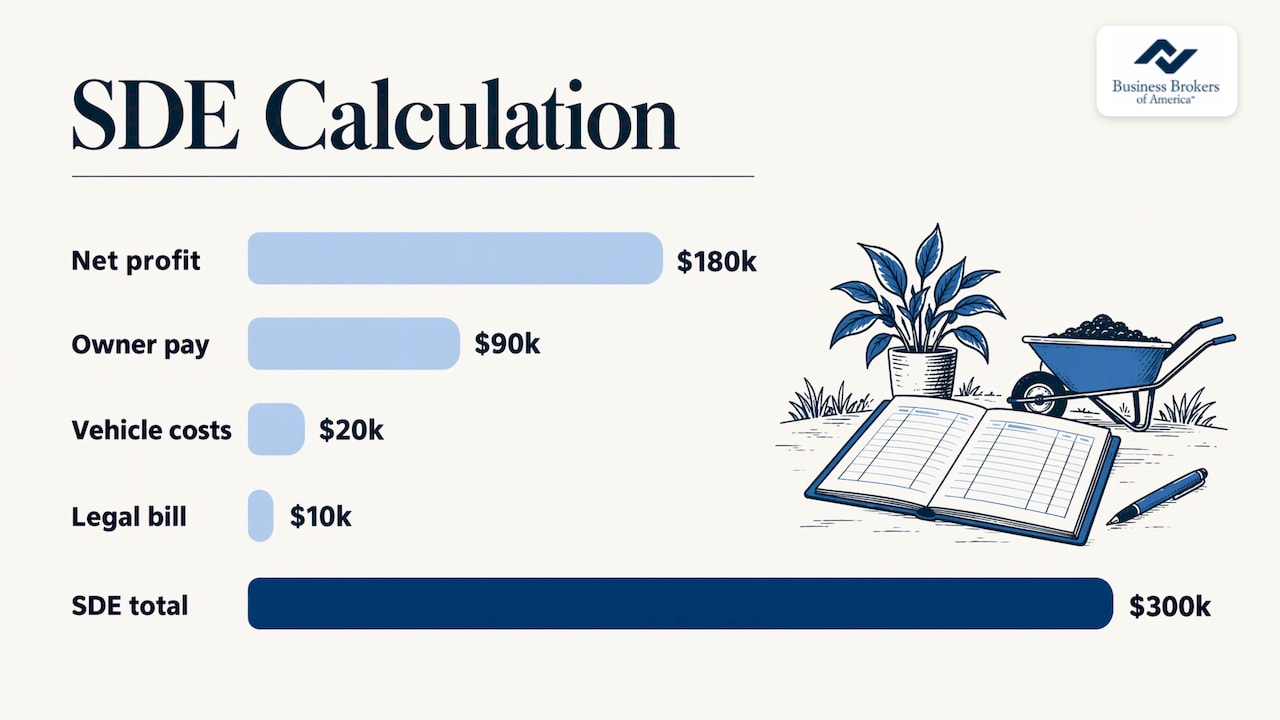
These ask what the business will earn for its next owner. For smaller owner-operated companies, the usual measure is seller’s discretionary earnings (SDE): net profit plus the owner’s salary, owner benefits and non-recurring expenses. A multiple is then applied to SDE. Larger or more complex companies often use a discounted cash flow analysis, which estimates the present value of projected cash flows plus a terminal value. The result is a figure that reflects both near-term earnings and long-term prospects.
Market-based methods
These ask what similar businesses have sold for. The method relies on comparable recent sales, which is why the quality of the sale data behind a valuation matters so much. Our valuations use closed-deal data, so the multiple reflects what buyers have actually paid, not what listings ask.
Asset-based methods
These total up what the company owns and subtract what it owes. They matter most for asset-heavy businesses, or when earnings are weak.
A careful provider does not average these mechanically. It weighs each approach by how well it fits your business and explains why. For a worked example of the small-business version, see our step-by-step guide to determining small business value and our explainer on how small businesses are valued before a sale.
A simple illustration
Suppose a landscaping company shows $180,000 in net profit. The owner pays herself $90,000 and runs $20,000 of personal vehicle costs through the business, plus a one-time $10,000 legal bill. Her SDE is $180,000 + $90,000 + $20,000 + $10,000 = $300,000. A buyer or valuation professional would then apply a multiple suited to her industry, size and risk. The multiple, not the arithmetic, is where experience and comparable sales data earn their keep. The numbers here are illustrative, not a prediction for any business.
What information affects the result
The inputs you supply set the ceiling on the quality of any valuation. The US Chamber of Commerce lists at least three years of profit-and-loss statements, balance sheets, cash flow statements and tax returns, plus inventory lists, customer metrics, liabilities and intellectual property.
Beyond the paperwork, these factors move the number:
- Earnings trend. Rising profit supports a higher multiple than flat or falling profit.
- Owner dependence. If customers and processes depend on you personally, buyers see risk.
- Customer concentration. One client producing a large share of revenue lowers value.
- Recurring revenue. Contracts and repeat business are worth more than one-off sales.
- Record quality. Clean, consistent books make buyers trust your numbers.
- Industry and market conditions. Buyer demand varies by sector and period.
Before any valuation, gather your documents. Our lists of top business sale documents needed and the preparing to sell checklist show what to pull together.
Types of valuation reports and what they cost
Costs depend on the type of report, the size and complexity of the company and the experience of the appraiser. Advisorpedia lists two main levels:
| Report type | Typical cost | Best suited to |
|---|---|---|
| Calculation of value | $1,500 to $5,000 or more | Exit planning, gifting, estate calculations |
| Full opinion of value | $5,000 to $50,000 or more | Ownership transfers, disputes, formal legal and tax needs |
The same source notes that a calculation of value is useful for planning but is not the right tool for transferring ownership. It also notes that reliability rises with an appraiser’s experience, giving the example of someone who has completed about 100 valuations in five to ten years.
Those are market ranges for stand-alone reports from independent appraisers. For owners who plan to sell, there is another route: our valuation sits inside the sale process, and our fee for a completed sale is success-based, as described on our success-based fee page. We publish no price for either.
Who should perform the valuation
A common question is whether your accountant can do it. Accountants know your books better than anyone, and many valuation professionals are CPAs. The US Chamber of Commerce notes that US valuations are usually carried out by a professional Accredited in Business Valuation (ABV), a credential the AICPA awards to CPAs who pass an exam and meet its standards. The AICPA’s own page confirms the exam and education requirements.
For a legal, tax or court-related report, ask for a credentialed appraiser and have your attorney or CPA confirm which standard the situation requires. For a sale, the person who values your business should also understand what buyers are paying right now, which is knowledge that comes from closing deals.
How to compare valuation providers
Whatever name the provider uses, compare on these points:
- Credentials and experience. Ask which credentials the appraiser holds and how many valuations they complete in a year, in your industry and size range.
- Scope. Is it a calculation or a full opinion of value? Which standard of value does it use, and for what purpose?
- Method. Will they use more than one approach and explain how they weighed them?
- Data. Where do the comparables come from? Closed sales are stronger evidence than asking prices.
- Independence. Does the provider have a stake in the outcome? For a sale, that is fine and expected, as long as the method is transparent.
- The report. Will you get written reasoning you can show a buyer, lender or advisor?
- What comes next. Does the number connect to a plan for preparing and marketing the business?
Our guide to choosing the right business broker applies the same questions to the broker who will carry the valuation into a sale.
How to raise the number before you sell
A valuation is a snapshot, and most owners can improve it. Common levers include documenting add-backs, reducing owner dependence, diversifying customers, moving toward recurring revenue and cleaning up the books. Allow 12 to 18 months where you can. Our guide on how to increase business sale value covers the practical steps, and our article on selling a service-based business shows how they apply to service companies.
Where our valuation fits
Business Brokers of America helps owners sell with data-based valuations, exit and market-preparation guidance, confidential nationwide buyer marketing, buyer screening, offer management, negotiation and support through closing. We operate in California, Arizona, Utah, Idaho and Nevada. Our valuations use real industry data from closed deals, and our advisors have built and sold businesses themselves.
The number also feeds a strategy. We typically average eight bids per deal, because competing offers are what tend to lift price above a single buyer’s opening position. If you are weighing a sale, start with a business valuation from our team, then see how our sell-side services carry it through to closing.

If you are comparing a broker with an M&A advisor for a larger company, see business broker vs M&A advisor. Once offers arrive, negotiation support and transaction management keep the deal moving to closing, and our guide to due diligence before selling shows what buyers will examine.
FAQ
How much do business valuation services cost?
Independent appraisers charge by report type. Advisorpedia lists $1,500 to $5,000 or more for a calculation of value and $5,000 to $50,000 or more for a full opinion of value. Size, complexity and appraiser experience drive the fee. We publish no price for our valuation.
What is the difference between a valuation expert and a valuation firm?
An expert is an individual appraiser or advisor who analyzes your company and signs the conclusion. A firm is an organization that employs several of them and usually handles larger or more formal engagements. In both cases, look for the credentials, the experience in your industry and a written explanation of the method.
Can my accountant value my business?
Often yes, especially a CPA who holds the ABV credential, which the AICPA awards after an exam. For a sale, pair that accounting knowledge with current deal data on what buyers pay for businesses like yours.
What documents do I need for a valuation?
Plan on at least three years of profit-and-loss statements, balance sheets, cash flow statements and tax returns, plus inventory, customer information, liabilities and intellectual property. Our sale documents list covers the rest.
How long is a valuation good for?
There is no fixed expiry. A valuation reflects your finances and market conditions on its date, so update it when earnings change meaningfully or when you are about to go to market.
Sources
- US Chamber of Commerce: What is a business valuation and how do you calculate it?
- Advisorpedia: Valuation types, costs and degrees of reliability
- AICPA: Accredited in Business Valuation (ABV) credential
- Revenue Ruling 59-60 explained
Recommended
Related articles